

Close Menu
    Facebook X (Twitter) Instagram
    Trending
    • The Best Black Friday Deals for Capture One Photographers
    • The New Capture One 16.7 – Three Amazing Use Cases
    • Capture One 16.7: Combine Masks, Better Retouching and More
    • Capture One 16.6.5 – Blemish Protection, Output Folder in Session Folders, Sony RX1R III
    • Top Free AI Tools for Photographers
    • Capture One AI Retouching – Everything You Need to Know
    • Capture One 16.5.6 – Grayscale Editing, iPhone DNG to EIPs, and other improvements
    • Capture One 16.5.5 Separate People Masks and Canon 16-28mm
    Facebook X (Twitter) Instagram
    Capture One Pro Tutorials, Styles, Courses, Books
    • Articles
    • Contacts
    • Styles
      • NEW! Street & Travel Styles
      • New! Layers Starter Kit
      • NextGen Landscape Styles
      • Adaptive Styles
      • NextGen Styles
      • Capture One Styles FREE
      • Ultimate Capture One Toolkit
      • Film Styles for Capture One
      • Creative Styles
      • Capture One Pro Color Grading Styles
    • TUTORIALS
      • NEW! Color Grading in Capture One
      • Capture One Expert Course
      • Capture One Hidden Features eBook
      • Capture One Best Practices
      • Capture One Shortcuts Cheat Sheet
      • Capture One Webinars
      • AI-Native Photographer Online Course
      • Practical AI Course
      • Capture One Script Generator
      • Capture One Assistant
      • AI-Powered Workflow for Photographers
    • Capture One Expert Course
    • FREE: 65 STYLES FOR CAPTURE ONE
    Capture One Pro Tutorials, Styles, Courses, Books
    Home»Articles»Balancing Color Temperatures in Capture One
    Articles

    Balancing Color Temperatures in Capture One

    Alexander SvetBy Alexander SvetOctober 24, 2019
    Facebook Twitter Email LinkedIn WhatsApp Reddit Tumblr
    Share
    Facebook Twitter LinkedIn Email Telegram WhatsApp

    Different light sources have various color temperatures. For instance, a standard incandescent lamp is much warmer than daylight. Thus, if you have distinct light sources in a scene, it’s impossible to set a correct WB using only White Balance tool.

    Luckily, Capture One offers plenty of ways to edit such images.
    In some of the cases, you can go with a simple gradient mask. It works well for scenes where you have natural light from a window and artificial light from a lamp.
    Things get a bit more complicated if you’re dealing with mixed light sources across the whole image.

    In this case, you can create a masked layer from a target color:
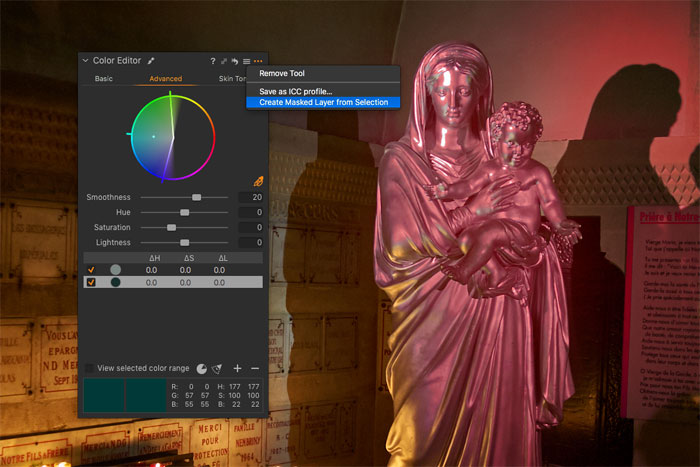
    Don’t forget to refine the mask – the correction would look much more accurate.
    Now, set WB for selected areas to balance color temperatures.

    Share. Facebook Twitter Pinterest LinkedIn Tumblr Telegram Email
    Alexander Svet

    Alexander Svet – Professional photographer and photography instructor. Phase One Certified Professional and Capture One beta tester.

    Related Posts

    The New Capture One 16.7 – Three Amazing Use Cases

    November 7, 2025

    Capture One 16.7: Combine Masks, Better Retouching and More

    October 3, 2025

    Top Free AI Tools for Photographers

    June 20, 2025

    Follow @AlexOnRAW

    Recent Posts
    • The Best Black Friday Deals for Capture One Photographers
    • The New Capture One 16.7 – Three Amazing Use Cases
    • Capture One 16.7: Combine Masks, Better Retouching and More
    • Capture One 16.6.5 – Blemish Protection, Output Folder in Session Folders, Sony RX1R III
    • Top Free AI Tools for Photographers
    Copyright 2024 Afterimages OÜ
    Reg. nr. 16195804
    Address: Estonia, Harju maakond, Tallinn, Kesklinna linnaosa, Luise tn 4-46, 10142
    Customer service email: [email protected]
    Privacy policy  Refund policy  EULA

    My Capture One Course
    Capture One Styles Free Download
    Capture One Film Styles
    Capture One Color Grading Styles
    Capture One Book
    Capture One Scritps
    Capture One AI Masking
    Capture One Black Friday

    Type above and press Enter to search. Press Esc to cancel.